English
 عربي
عربي 
Slitting speed is not simply a production rate. In roll-to-roll converting, it directly affects web tension stability, slit edge quality, blade wear rate, and the consistency of rewound rolls. Higher speed can increase output, but only when tension control, blade condition, and material properties are matched to the operating window. This article explains how speed interacts with these variables and what to check before adjusting slitting parameters.
What Slitting Speed Actually Controls
In a slitting machine, the speed setting influences more than how many meters of material pass through per minute. It shapes the entire converting dynamic:
-
Web tension profile: As speed increases, the inertia of the unwinding and rewinding rolls changes. A tension setting that holds a stable web at 150 m/min may become unstable at 400 m/min without closed-loop compensation.
-
Knife engagement dynamics: Higher web speeds increase the instantaneous contact force between the blade and the material. This affects slit edge quality and blade life.
-
Air entrainment between layers: At higher rewinding speeds, more air is trapped between wound layers, which can lead to softer rolls and telescoping if taper tension is not adjusted.
-
Rewinding roll hardness: Speed affects how quickly the rewinding diameter changes, which in turn changes the required tension to maintain consistent roll density.
The Speed–Tension Balance
Tension control is one of the most critical technical elements in a slitting machine. It regulates web force as material is unwound, slit, and rewound. Proper tension keeps the material stable and flat, even at high operating speeds.
The relationship between speed and tension is not linear. Consider a closed-loop tension system using a magnetic powder brake and load cell. At low speeds, minor tension fluctuations may not produce visible defects. At high speeds, the same fluctuation can cause edge wander, wrinkles, or roll telescoping.
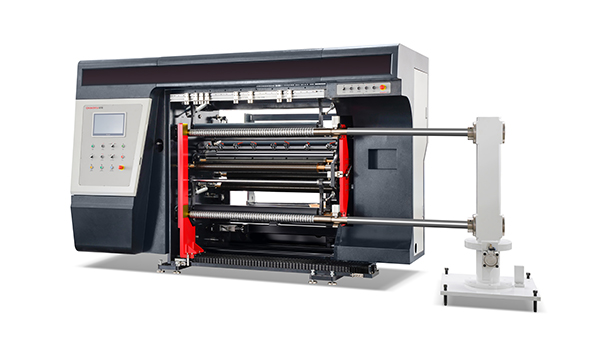
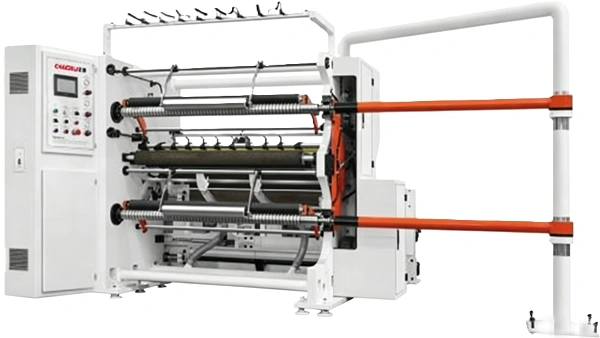
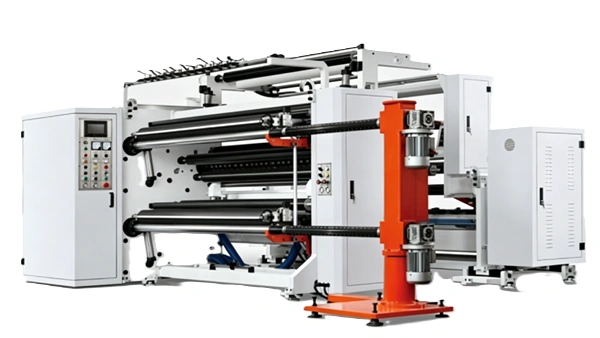
A practical implication: when you increase line speed, you should verify tension response time and controller tuning. A tension controller that works well at 100 m/min may require different PID parameters at 400 m/min. The CHAOXU CX-FQ series uses imported PLC with motor active unwinding and automatic tension control, designed to maintain stable tension across a 10–500 m/min speed range.
How Speed Affects Different Materials
Not all materials respond to speed the same way. Film, paper, and adhesive-coated materials have different tensile properties, friction coefficients, and air-entrainment characteristics.
| Material Type | Typical Speed Consideration | Key Risk at High Speed |
|---|---|---|
| BOPP/PET film | Thin gauge, low tensile stiffness | Edge curl, tension drift, air entrainment |
| Paper (kraft, label stock) | Higher basis weight, dust generation | Dust accumulation on blades, edge cracking |
| Adhesive paper | Tacky surface, release liner sensitivity | Adhesive transfer to knives, liner distortion |
| Aluminum foil | Low elongation, easy to wrinkle | Wrinkle formation, tension spikes |
| Laminated film | Multi-layer, differential stiffness | Delamination at slit edge, interlayer slippage |
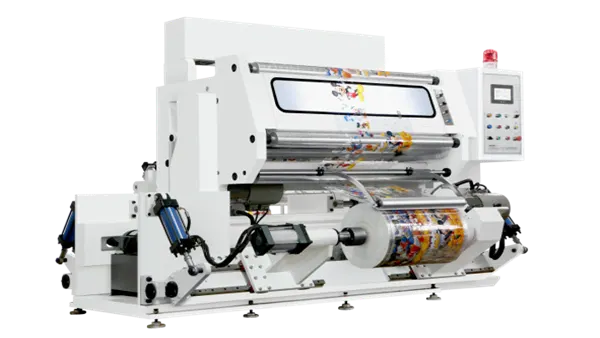
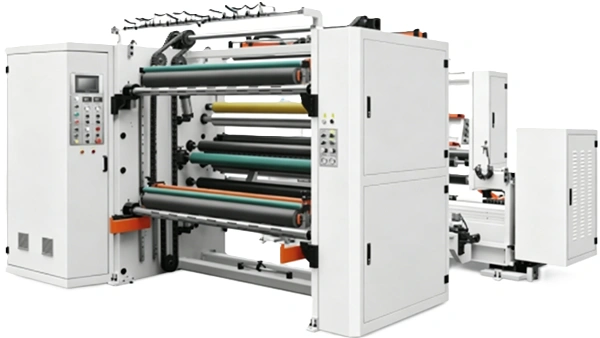
For film materials such as BOPP, PET, CPP, and PVC, the CX-FQ.A model is configured for slitting speeds up to 300 m/min with vector frequency conversion rewinding and PLC auto roll diameter calculation. For paper and self-adhesive materials, the CX-FQ.ZA paper slitting and rewinding machine operates at up to 400 m/min with round knife slitting and automatic tension control.
Blade Wear and Speed: A Direct Relationship
Blade wear is one of the most direct consequences of speed selection. The top knife in a shear slitting system wears out before the lower knife, and the wear interval depends on the material being slit, the speed, and the percentage of running time.
At higher speeds, blade run-out — even a small amount that is acceptable at lower speeds — causes more aggressive wear. Research on PET-based film slitting shows that cutting forces increase as the blade dulls and decrease with higher cutting speed, but the relationship depends on blade sharpness.
A practical guideline: if you increase slitting speed without adjusting blade overlap, cant angle, or knife sharpness, you may see edge quality deteriorate before the blade reaches the end of its normal wear life.

Why High Speed Can Improve Some Quality Outcomes
Higher speed is not always a quality risk. In some cases, it helps. At higher speeds, air lubrication reduces web-to-roller traction, which can reduce the ability of a roller to shift or gather the web into a buckled, wrinkled shape. This means certain thin films may actually run flatter at higher speeds than at very low speeds.
The practical takeaway is that speed should be evaluated as part of a system, not as an isolated setting. The optimal speed for a given material and machine configuration is the range where tension stability, edge quality, and blade life are all acceptable — not necessarily the maximum rated speed.
Checking Your Speed Setup: A Practical Checklist
Before adjusting slitting speed on a roll-to-roll line, verify the following:
- Tension controller response time is adequate for the target speed
- Taper tension profile is set for the rewinding diameter range
- Blade overlap and cant angle are appropriate for the material and speed
- Edge guide (EPC) tracking accuracy is within tolerance at target speed
- Air entrainment between rewound layers is controlled (check roll hardness)
- Dust or adhesive buildup on knives is monitored during extended runs
- Acceleration and deceleration ramps do not cause tension spikes
The CHAOXU slitting machine range includes models with EPC tolerance of ≤0.1mm (CX-FQ) and ≤0.4mm (CX-FQ.A), which provides a reference point for edge tracking accuracy under different speed conditions.
FAQ
Q1: Does higher slitting speed always mean lower roll quality?
A1: No. Higher speed can improve web flatness for some thin films by increasing air lubrication between the web and rollers. However, speed increases demand on tension control and blade condition. Quality depends on whether the machine’s tension, blade, and guiding systems are matched to the operating speed.
Q2: What is the typical speed range for a high-speed slitting machine?
A2: Speed ranges vary by machine configuration and material. For reference, the CHAOXU CX-FQ series operates from 10 to 500 m/min, the CX-FQ.A model up to 300 m/min, and the CX-FQ.ZA paper slitting and rewinding machine up to 400 m/min. The suitable speed for a specific application depends on material, tension requirements, and downstream process.
Q3: How does slitting speed affect tension control requirements?
A3: As speed increases, the inertia of unwinding and rewinding rolls changes more rapidly, requiring faster tension controller response and potentially different PID tuning. A tension setting that is stable at low speed may need adjustment at high speed.
Q4: Can I run a slitting machine at its maximum rated speed for all materials?
A4: No. Maximum rated speed is a machine capability, not a universal operating recommendation. Different materials have different tensile properties, friction characteristics, and blade wear responses. The practical speed should be confirmed through trial runs with the actual material.
Q5: What are the signs that slitting speed is too high for the material?
A5: Common indicators include edge cracking or curl, tension fluctuation visible in the rewound roll, telescoping or soft rolls, excessive blade wear over a short run, and dust or debris accumulation on the slitting station. If these appear, reduce speed or verify tension and blade settings before continuing.
Q6: How do I determine the right slitting speed for a new material?
A6: Start with a moderate speed, verify tension stability and edge quality, then increase gradually. Document the speed, tension profile, blade configuration, and roll hardness at each step. Discuss the material and production requirements with the equipment supplier to review available configurations for your specific application.
Conclusion
Slitting speed is a system variable, not a standalone target. The right speed is the one where tension control remains stable, slit edges meet quality requirements, blade wear stays within predictable intervals, and rewound rolls maintain consistent density. Before increasing speed, verify tension response, blade setup, and material compatibility. When these elements are aligned, higher speed can support both productivity and quality. When they are not, speed becomes a source of waste and rework.
For buyers reviewing slitting equipment for roll-to-roll converting, the machine’s tension control architecture, blade system, and speed range should be evaluated together. Review the available configurations to compare how different models approach the speed–tension–quality balance.