English
 عربي

The decisive difference between CI and inline flexo for thin film is not the printing principle—both are flexographic—but how each structure supports the web between color stations. A CI press holds the film against one temperature-controlled impression drum across all stations, keeping tension disturbances and thermal expansion from accumulating. An inline press carries the film through open spans between stations, where small tension changes can compound into register drift, especially on PE and other low-modulus films. This article explains the structural mechanics behind that difference and provides a comparison framework for buyers evaluating thin-film flexible packaging work.
The Structural Difference in One Sentence
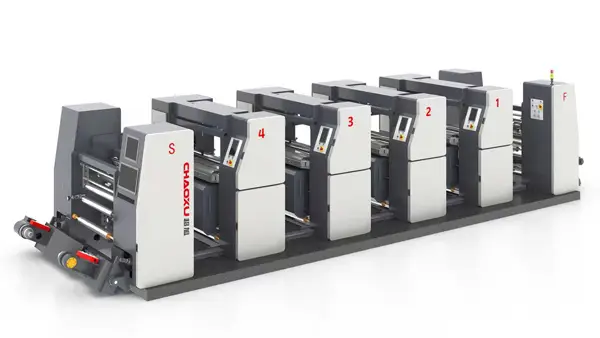
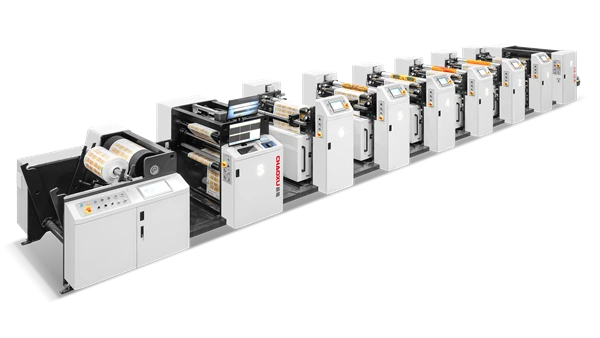
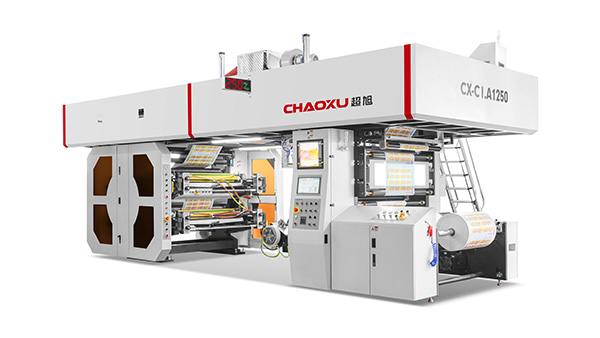
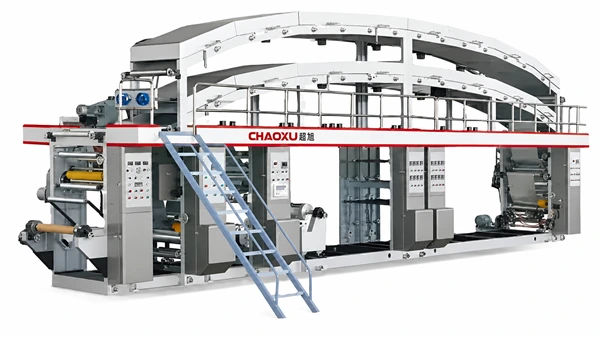
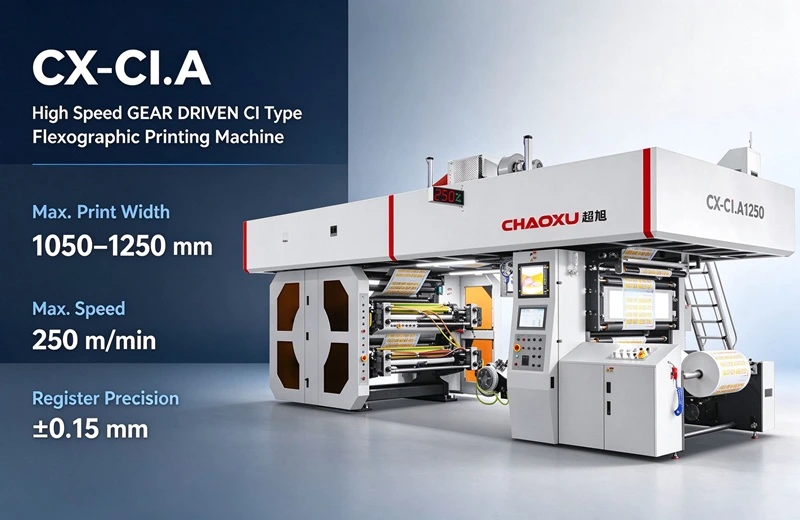
In a CI press, every color is printed while the film is supported by the same large drum. In an inline press, each station has its own impression cylinder, and the film travels unsupported between them. That is the entire architectural distinction, and almost every practical consequence for thin film follows from it.
What “Unsupported” Means for a Thin Film
A 12–30 micron PE or BOPP web is not a rigid sheet. It elongates under tension. When the film leaves one inline station and travels toward the next, it passes through an open span with no surface holding it flat. If unwind tension, infeed tension, or rewind tension fluctuates—or if a splice passes through—the film stretches or relaxes within that span, and the next color prints onto a web whose dimensions have already changed.
CI architecture removes most of that open span. The film wraps around the central drum and stays in contact with it as each station prints. The free section outside the drum is short, and the drum itself acts as a dimensional reference that is temperature-controlled in most industrial CI designs. The result is not that CI “eliminates” tension variation, but that the variation has far less opportunity to translate into color-to-color error before the next impression is made.
Key point for thin film buyers: registration on extensible film is first a web-handling problem, then a printing problem. The press structure determines how much of the web-handling problem the register control system has to correct in real time.
Why PE Is the Hardest Test Case
Polyethylene is soft, highly extensible, and sensitive to heat. Even a slight tension fluctuation can cause elongation or contraction that shows up as register deviation, image elongation, or edge curl. In an inline press, the unsupported span gives those fluctuations room to act. In a CI press, the drum constrains the film physically, so the same tension disturbance produces a smaller dimensional change at the moment of impression.
BOPP and PET are less extensible than PE but still benefit from continuous support. The difference is one of degree: a structure that holds registration on PE will generally have margin on BOPP and PET; a structure that only holds registration on thicker or stiffer films may struggle when the job mix shifts toward thinner PE.
Where Inline Flexo Retains the Advantage
The comparison is not one-sided. Inline architecture is structurally suited to integrating printing with downstream converting—lamination, die-cutting, slitting, or rewinding—in a single pass. If the production model depends on inline finishing rather than on pushing thin-film registration to its limit, an inline press can be a practical choice. The trade-off is that the longer web path and open spans between stations require more careful tension management to avoid stretching or wrinkling on thin films.
The selection question is therefore not “which structure is better,” but which constraint dominates the job mix: thin-film registration stability, or inline converting integration.
A Practical Comparison Framework
| Decision variable | CI flexo | Inline flexo | What to verify with the supplier |
| Web support between stations | Continuous around a central drum | Unsupported open spans | Free span length; drum temperature control |
| Tension disturbance path | Short free section; disturbances do not travel across multiple open spans | Disturbances can accumulate across stations | Closed-loop tension zones; taper tension capability |
| Thin PE / extensible film | Structurally favored for registration stability | Requires tighter tension management; higher risk on very thin or soft films | Minimum film thickness and modulus the register system is specified for |
| BOPP / PET film | Suitable; margin generally greater than on PE | Can perform well within specified tension windows | Film thickness range; register accuracy under production speed |
| Inline converting | Not the primary design intent | Strong structural advantage for print-plus-converting | Which converting modules are required; effect on web path |
| Changeover and job mix | Drum access and plate change workflow should be reviewed | Station access may be simpler for some inline configurations | Changeover procedure and plate mounting system |
The comparison reflects structural tendencies, not fixed performance guarantees. Actual results depend on film grade, thickness, ink system, drying/curing method, tension control configuration, and operating speed.
A Buyer’s Checklist Before Choosing a Structure
Use this list to frame the technical discussion with any press supplier, including Chaoxu.
- Film grade and thickness range. List every film you expect to run—PE, BOPP, PET, CPP, metallized—with minimum and maximum thickness. A structure that fits 40-micron BOPP may not fit 15-micron PE.
- Register tolerance by color count. Define the acceptable color-to-color error for the most demanding job, not the average job. Ask how that tolerance is verified at production speed, not only at low speed.
- Unsupported span length. For an inline candidate, ask for the distance between consecutive impression points. Longer spans on extensible film increase the exposure to tension disturbance.
- Tension control architecture. Confirm whether unwind, infeed, each station (where applicable), and rewind have independent closed-loop control, and whether taper tension profiles can be set per film type.
- Drum temperature control on CI. The central drum’s thermal stability affects repeat length and film dimensional stability. Confirm the control method and operating range.
- Drying or curing heat load. On PE, excessive drying temperature can cause shrinkage and wrinkling. Match the drying/curing system to the film’s heat sensitivity.
- Job mix and changeover frequency. If short runs across multiple films are expected, evaluate how quickly plate changes and tension recipe recalls can be completed.
- Inline converting requirements. If lamination, die-cutting, or slitting must run in line, compare the integrated configuration against a separate converting step rather than forcing a CI press into a converting role it was not designed for.
How This Connects to Press Selection
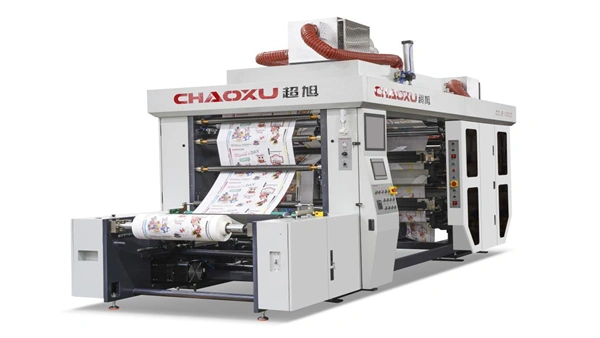
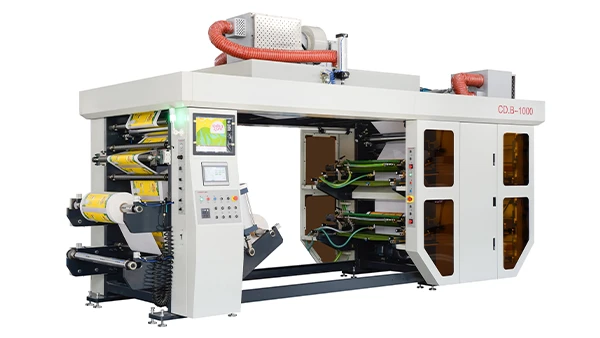
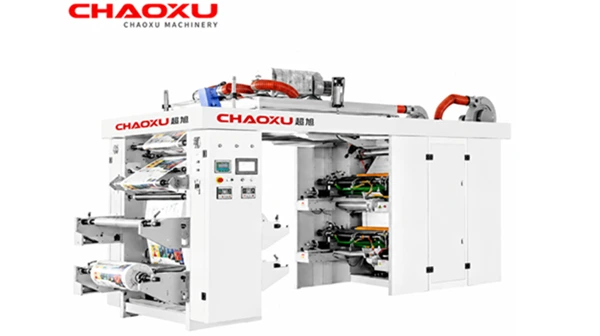
Once the structural direction is clear, the next step is to review the available configurations around material, width, color stations, drying method, and downstream requirements. The flexographic printing machine category page organizes Unit Type, CI Type, and Stack Type families by substrate and production target, and is the appropriate place to shortlist a model family before requesting a detailed specification. For film-oriented work, the CI press configurations are specified for BOPP, OPP, PE, PVC, and PET, and should be reviewed against the film list and thickness range identified in the checklist above.
FAQ
Is CI flexo always better than inline flexo for thin film?
No. CI architecture is structurally favored for registration stability on extensible films because the web is continuously supported. But inline flexo offers a structural advantage when printing must be integrated with lamination, die-cutting, or other converting steps. The right choice depends on which constraint is more important for the specific job mix.
Why does an inline press struggle more with PE film registration?
PE has a low modulus and elongates easily under tension. Between inline stations, the film passes through an unsupported span. Small tension fluctuations in that span change the film’s length before the next color is printed, producing register drift. A CI press shortens that unsupported path by holding the film against the central drum.
Can an inline press run BOPP and PET film successfully?
Yes, within appropriate tension windows and with suitable register control. BOPP and PET are less extensible than PE, so the unsupported span has less effect. Performance depends on film thickness, press tension control, drying heat load, and operating speed, and should be confirmed with production testing or a verified reference.
Does the central drum temperature matter for thin film?
Yes. The drum acts as a dimensional reference for the film. If drum temperature is not controlled, thermal expansion or contraction can change the effective repeat length. On heat-sensitive films such as PE, both drum temperature and drying heat load should be reviewed together.
What film details should I prepare before asking for a press quotation?
Film type, minimum and maximum thickness, expected width, color count, required register tolerance, production speed target, ink system, and any inline converting requirements. These determine both the feasible structure and the configuration details.
Conclusion
For thin-film flexible packaging, the CI versus inline decision is best approached as a web support question rather than a brand or model comparison. CI architecture reduces the unsupported span between colors, which gives the register system less accumulated tension disturbance to correct. Inline architecture retains a clear advantage in integrated converting, but places more demand on tension management when the film is thin and extensible. Before committing to a structure, verify the film list and thickness range, the required register tolerance at production speed, the tension control architecture, and the drying heat load. If the job mix is PE-heavy or spans multiple extensible films, the technical discussion should start with how the press supports the web, not with a headline speed figure. The flexographic printing machine selection overview is the next place to compare model families against those confirmed requirements.