English
 عربي

Converting a flexo press from water-based ink to UV ink is not a matter of draining one ink and filling another. The two ink systems differ in how they transfer from the anilox cell, how they solidify on the substrate, and how they interact with the photopolymer plate surface. A practical conversion starts with three engineering questions: Can the existing anilox volume deliver a UV-appropriate ink film? Does the press have the physical space and power infrastructure for UV curing modules? And are the plates in use resistant to the monomer components in UV inks? This article provides an evaluation framework for answering those questions before capital or production time is committed.
Why Water-Based and UV Inks Are Not Interchangeable at the Unit Level
The difference begins with the curing mechanism. Water-based inks solidify primarily through evaporation of water and co-solvents, which requires sustained hot-air or infrared energy and effective moisture removal from the web path. UV inks cure through a photochemical reaction initiated by ultraviolet light; the vehicle does not need to evaporate, and the ink remains fluid on the plate and in the anilox cells until it reaches the curing lamp.
A press configured for water-based drying typically carries a long hot-air or IR tunnel with calibrated exhaust and dehumidification. UV curing modules are comparatively compact but require line-of-sight access to the freshly printed web, cooling (air or water), and power supplies that may not exist on a water-based line. The conversion question is therefore not “which ink is better,” but “which subsystems need to change to match the new ink’s behaviour.”
Anilox Evaluation: Volume, Geometry and Release
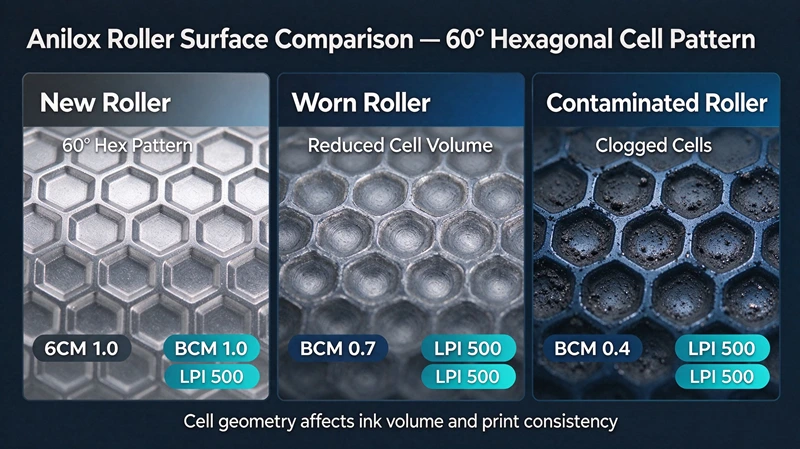
The anilox roller is the metering device for the entire ink film. Its cell volume (BCM, billion cubic microns per square inch) and screen count (LPI, lines per inch) determine how much ink reaches the plate and how that ink releases under impression.
UV flexo inks are generally higher in viscosity and contain a higher solids loading than water-based inks. They do not thin by evaporation on the roll, and they release differently from a cell because the fluid resists flow until shear is applied. As a practical starting point, industry reference ranges for UV flexo on labels and packaging sit at roughly 400–700 LPI and 1.8–4.0 BCM, while water-based paper/board applications commonly run 200–360 LPI and 4.0–8.0 BCM. A separate reference places UV flexo at 800–1,200 LPI and 1.5–3.0 BCM, with water-based at 500–800 LPI and 3.0–4.0 BCM. The variation between sources reflects differences in substrate, anilox engraving, and target color density — these are starting ranges for discussion with an anilox supplier, not specifications to apply without testing.
Cell geometry matters alongside volume. The 60° hexagonal pattern is the common baseline for both water-based and UV inks, but UV inks are sometimes paired with 30° deeper cell profiles to support release of higher-viscosity fluid, at the cost of sharper cell walls and potentially more demanding cleaning. If the existing water-based anilox set is at the higher-BCM end of the water-based range, a UV conversion may produce excessive ink laydown, slower cure, and mottling unless lower-volume rollers or sleeves are introduced.
Anilox decision rule: If the existing anilox inventory cannot cover the target UV BCM range for the jobs in question, the conversion is not an ink change — it is an anilox inventory change. Banded anilox trials on the actual substrate remain the most reliable way to confirm volume before committing to a full set.
Drying vs Curing: Physical Space and Curing System Fit
The second system constraint is the drying/curing section. Water-based drying is an evaporation process: it requires residence time, airflow, temperature, and moisture exhaust. UV curing is an irradiation process: it requires the photoinitiator in the ink to absorb UV energy at the correct wavelength and dose within a short exposure window.
A press originally built for water-based ink may have a long tunnel that is poorly suited to UV module mounting, or it may have no spare deck space or web path length for a UV lamp at the required position after each printing unit. Retrofit UV LED modules are available in compact form factors, but they still require cooling and power infrastructure. Water-cooled systems manage heat more effectively at high power; air-cooled systems are simpler to mount but may have lower irradiance ceilings. Curing wavelength is also a fixed constraint: mercury arc lamps emit a broad spectrum, while UV LED modules typically emit at 385 nm or 395 nm, and the ink must be matched to the lamp spectrum, not the reverse.
Drying decision rule: The conversion should not proceed on the assumption that “UV cures faster, so the existing drying section can be bypassed.” The question is whether the press can physically accommodate curing modules at each required station, whether the electrical and cooling infrastructure supports them, and whether the ink supplier’s recommended dose can be achieved at the target press speed.
Plate Compatibility: Swelling and Cleaning Chemistry
Photopolymer plates are not uniformly resistant to all ink chemistries. UV inks can affect plate material more than water-based inks because certain monomer components in UV formulations can swell and soften the photopolymer surface. A plate that performs consistently in a water-based operation may exhibit edge swelling, dot gain drift, or reduced relief depth after repeated exposure to UV ink unless the plate is selected for UV resistance.
This does not mean every water-based plate must be replaced. Many commercial photopolymer plates are documented as compatible with water-based, solvent, and UV inks when used within the manufacturer’s recommended conditions. The practical check is to verify the plate datasheet’s ink compatibility statement against the specific UV ink chemistry being considered — not all UV inks are identical, and “UV compatible” on a plate datasheet is a starting point rather than a blanket guarantee. Cleaning chemistry must also change: residues from conventional water-based plate washes can interfere with UV ink transfer and adhesion if not fully removed before the first UV run. If transfer defects persist after conversion, the diagnostic sequence for anilox and impression settings covered in a separate flexo troubleshooting framework may help isolate whether the issue is ink delivery, plate condition, or curing.
Plate decision rule: Request the UV ink’s technical data sheet and the plate’s ink compatibility declaration, and run a controlled plate life trial under production-representative conditions before replacing the plate inventory. If the existing plates are not explicitly rated for the UV ink chemistry, plan for a plate evaluation as part of the conversion budget.
Conversion Evaluation Checklist
The table below organises the evaluation into decision gates. It is a screening tool for technical discussions, not a substitute for supplier confirmation or on-press testing.
| Evaluation area | What to confirm before conversion | Why it matters |
| Anilox | Existing BCM/LPI vs target UV range; availability of lower-volume rollers or sleeves; ceramic condition | Prevents over-inking, slow cure and mottling |
| Curing / drying | Physical space for UV modules at each station; power capacity; cooling (air/water); lamp wavelength matched to ink | UV curing cannot rely on evaporation; infrastructure is a hard constraint |
| Plates | Ink compatibility statement for the specific UV chemistry; swelling resistance; cleaning chemical compatibility | Plate swelling and cleaning residue directly affect transfer and dot gain |
| Ink delivery | Pump, chamber doctor blade and filtration compatibility with higher-viscosity UV ink | Water-based delivery hardware may not meter UV ink consistently |
| Operational | Training on UV ink handling, viscosity control, cleaning routines and cure verification | UV inks behave differently at stoppages and during make-ready |
| Regulatory | Food-contact migration testing requirements for the intended market | UV inks may require additional residual monomer testing |
What the Conversion Does Not Fix
A UV conversion improves cure speed and may reduce the floor space and energy associated with evaporation-based drying, but it does not automatically improve registration, tension control, or substrate handling. If the press has unresolved web tension or register issues on water-based ink, those issues will not disappear with UV. Similarly, a UV conversion does not eliminate the need for anilox cleaning and maintenance; it changes the cleaning chemistry and the consequences of inadequate cleaning. UV ink left on a plate or anilox between jobs does not dry in the same way as water-based ink, but contamination and residual cleaning agents can still cause transfer defects.
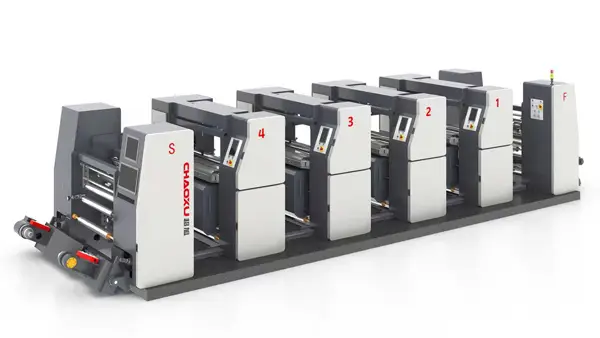
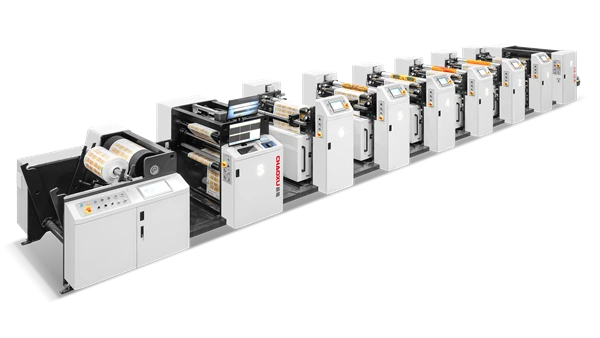
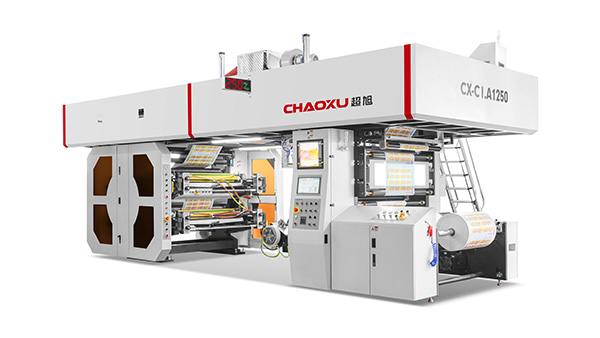
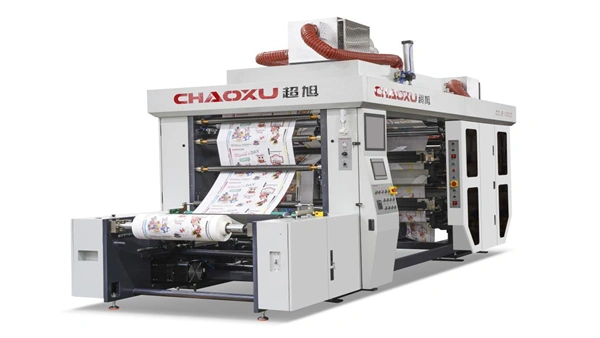
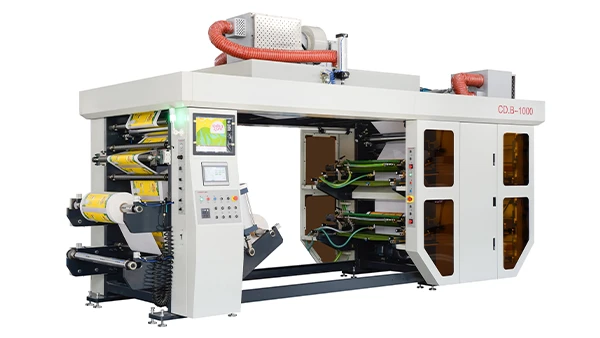
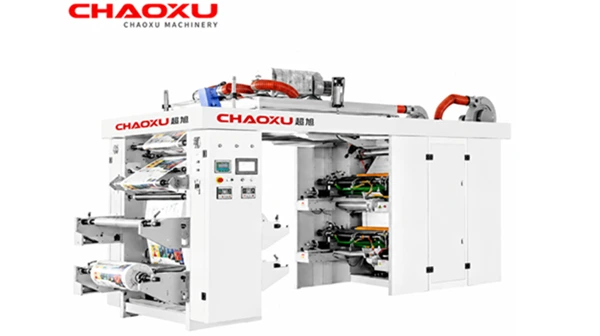
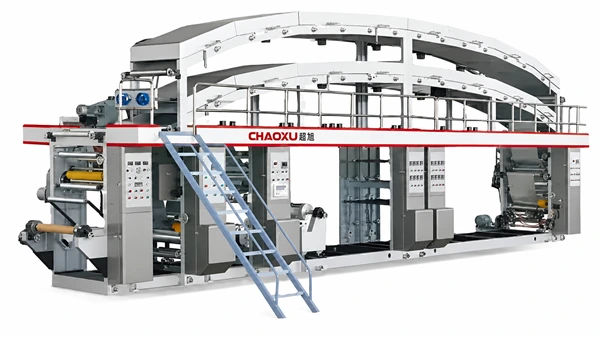
For operations evaluating whether the existing press platform can support the conversion at the required width, speed and drying configuration, the available model families and their drying options can be reviewed at the flexographic printing machine overview. This is a technical confirmation step, not a purchase recommendation — the conversion may be feasible on the existing platform with anilox and curing changes, or it may indicate that a different configuration is needed.
FAQ
Can I run UV ink through an anilox roller that was sized for water-based ink?
Sometimes, but not reliably across a full job mix. Water-based anilox volumes often sit above the range typically used for UV flexo. If the existing roller delivers more ink than the UV system can cure at production speed, you may see slow cure, tracking, or mottling. A banded anilox trial is the practical way to confirm whether the existing volume is workable for the target jobs.
Do I need new plates for UV ink?
Not necessarily, but you need plates whose ink compatibility statement covers the specific UV chemistry in use. Many photopolymer plates are rated for water-based, solvent and UV inks, but UV inks can swell plates that were not formulated for UV exposure. Check the plate datasheet and run a controlled life trial.
Can a water-based drying tunnel be converted to UV curing?
The tunnel itself is usually not the conversion target. UV curing requires lamp modules, cooling and power at the printing stations, not a hot-air tunnel. The practical question is whether the press frame and web path have space for those modules and whether the electrical infrastructure can support them. A long water-based tunnel may remain unused or be repurposed, but it does not become a UV curing system.
Does UV ink eliminate the need for drying energy?
UV curing eliminates evaporation-based drying energy, but it introduces electrical demand for lamp power and cooling. The net energy profile depends on press speed, lamp type (mercury vs LED), and the number of stations — it should be calculated from actual equipment specifications rather than assumed.
What is the first thing to check before committing to a conversion?
The anilox inventory and the plate compatibility statement. If the existing anilox volumes are far outside the UV range for the target work, or the plates are not rated for the UV ink chemistry, the conversion scope changes from “ink swap plus lamps” to “anilox and plate change plus lamps.” Confirming those two items first prevents under-budgeting the project.
Conclusion
The decision to convert from water-based to UV ink on a flexo press hinges on three compatibility checks, not on a general preference for one ink chemistry. Anilox volume must be able to deliver a UV-appropriate film without exceeding what the curing system can solidify; the press must have the physical and electrical space for UV modules at each station; and the plate must be resistant to the specific UV ink chemistry in use. If any of those three is uncertain, the conversion should be treated as an engineering evaluation with supplier input and on-press trials, not as a consumables change.
The most common planning error is to budget only for ink and lamps while overlooking anilox inventory, plate replacement, and cleaning chemistry changes. A second error is to assume that a water-based drying tunnel can be “switched” to UV without confirming module mounting space and power capacity.
When the evaluation indicates that the existing press platform can accommodate the required anilox, curing and plate changes, the next step is to confirm the specific configuration details — web width, station count, drying/curing arrangement and speed target — against the available flexographic press families and their technical specifications. That confirmation should be based on the actual job mix and substrate list, not on a generic conversion template.