English
 عربي

Short-run slitting production often involves frequent changes in roll width, material specifications, finished roll dimensions, and order quantities. The time required to prepare each new job can therefore become a significant part of total production time. PLC-based parameter control, accessible job settings, automatic tension control, edge guiding, and production monitoring can help simplify the setup process. However, their actual value depends on which adjustments are automated, which still require manual work, and how consistently the setup procedure is followed.
Why Changeover Time Matters in Short-Run Slitting Production
In long production runs, setup time is distributed across a relatively large volume of finished material. In short-run production, the same preparation work must be repeated more frequently, making every changeover more noticeable.
For example, a converter processing several different packaging film widths may need to adjust the knife arrangement, confirm the web path, reset tension values, and check the finished roll dimensions before starting the next order.
Even when each individual adjustment takes only a short time, the combined preparation process can delay production.
The challenge is not simply to increase the machine's running speed. It is to reduce unnecessary adjustments, repeated parameter entry, and avoidable trial runs between jobs.
A practical way to understand this process is to divide changeover time into five stages:
-
Job review and specification confirmation.
-
Mechanical preparation and knife positioning.
-
Parameter adjustment and tension setting.
-
Trial running and initial inspection.
-
Quality verification and production restart.
Different automation features support different stages. Understanding this relationship helps buyers evaluate equipment according to their actual production requirements rather than relying on a general automation label.
1. PLC and Touchscreen Control for Faster Parameter Preparation
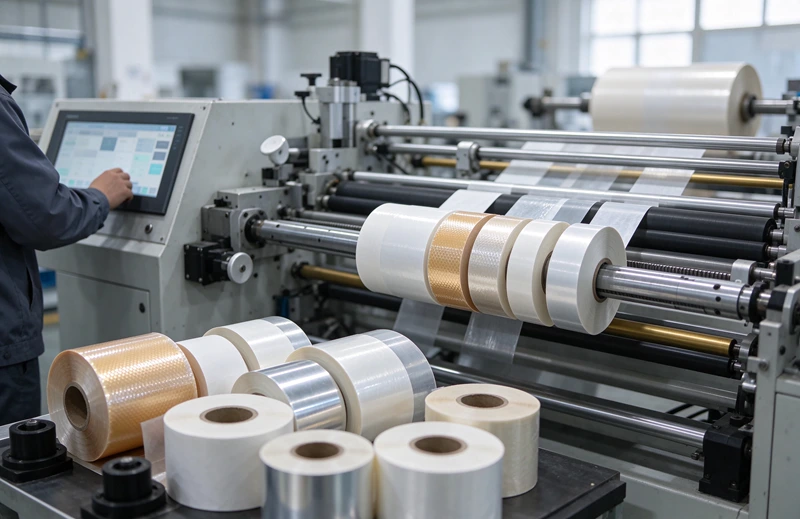
A PLC-based control system with a touchscreen HMI gives operators a centralized interface for setting and monitoring machine operating parameters.
Without centralized parameter control, operators may need to check multiple adjustment points, enter settings separately, or rely heavily on handwritten production records.
A centralized interface can make the preparation process more organized by allowing operators to review relevant settings from one control point.
For short-run production, buyers should pay attention to the following functions:
-
Clear display of operating parameters.
-
Accessible settings for different production requirements.
-
Consistent parameter input procedures.
-
Real-time display of machine operating conditions.
-
Support for preset parameter storage and recall, where available.
An important distinction is that parameter setting and recipe management are not necessarily the same function. A touchscreen that allows operators to enter and display settings does not automatically mean that it can store multiple job recipes or recall an entire set of production parameters.
Before purchasing, confirm whether the selected configuration supports job memory, recipe naming, parameter grouping, and one-touch recall.
2. Knife Positioning and Slitting Width Adjustment
Knife setup is often one of the most time-consuming mechanical tasks when changing orders with different finished roll widths.
The required knife arrangement depends on the number of finished rolls, individual slit widths, edge trim requirements, and the cutting method.
For example, changing from a wide finished roll to several narrower rolls may require operators to reposition multiple knives and verify their spacing before production resumes.
The setup process generally includes:
-
Reviewing the new slitting layout.
-
Confirming the required number of cutting lanes.
-
Adjusting knife positions and spacing.
-
Checking blade condition and cutting alignment.
-
Verifying the cutting arrangement before restarting.
Automatic knife positioning can help reduce manual adjustment work when the machine is specifically equipped with a servo-driven positioning system and compatible job management controls.
However, this feature should not be assumed to be standard on every automatic slitting machine.
When comparing configurations, ask whether knife positioning is manual, assisted, or fully automatic. Also confirm the supported positioning range, adjustment accuracy, and whether the machine can save and recall knife layouts.
A machine with automatic parameter control but manual knife positioning may still require considerable mechanical preparation when changing slit widths.
3. Automatic Tension Control for More Consistent Job Preparation
Web tension affects material stability during unwinding, slitting, and rewinding.
If tension is too high, certain films or lightweight materials may stretch or deform. If tension is too low, the web may become unstable, wrinkle, or produce uneven winding.
For this reason, tension adjustment is an important part of preparing a new slitting job.
A closed-loop automatic tension control system uses feedback from sensors to regulate tension during operation. Depending on the machine configuration, automatic tension control can reduce the amount of continuous manual adjustment required from the operator.
For short-run production, buyers should examine three main areas:
Unwinding tension
The incoming roll must be unwound under conditions appropriate for the material and roll characteristics.
Slitting process stability
The material should remain stable as it passes through the cutting section. Tension should be suitable for the substrate and operating speed.
Rewinding tension
The winding tension should support the required finished roll structure without creating excessive tightness or loose winding.
Taper tension control is also worth considering. It allows winding tension to change as the roll diameter increases, helping maintain suitable winding conditions throughout the process.
However, automatic tension control does not eliminate the need to establish appropriate target values for each material and job.
For converters processing different films, paper grades, or adhesive materials, the ability to define and consistently apply suitable tension settings is particularly important.
4. Automatic Edge Guiding to Reduce Web Alignment Adjustments
Web alignment is another important consideration when preparing a new job.
If the incoming material is not correctly aligned, the finished slit rolls may have inconsistent edges or uneven positioning.
An edge position control system, commonly referred to as EPC, detects the web edge and adjusts the guiding mechanism to maintain the required material position.
For short-run production, this function can help reduce repeated manual alignment corrections during startup and operation.
When evaluating an edge guiding system, check:
-
Whether the system supports the material edge or line-tracking method required by the application.
-
The available correction range.
-
The specified correction accuracy.
-
Whether the sensor is suitable for the material surface and edge characteristics.
-
Whether alignment remains stable at the intended operating speed.
Automatic edge guiding should not be confused with automatic knife positioning. The former controls web alignment, while the latter changes the physical location of the cutting tools.
Both can affect setup work, but they solve different production problems.
5. Length Counting and Roll Diameter Calculation
Production monitoring functions can also simplify order preparation and improve consistency between jobs.
Length counting allows operators to monitor processed material length, while roll diameter calculation helps track the winding process.
When a production order requires a specified finished length or roll diameter, these functions provide useful information for controlling the stopping point.
Depending on the equipment configuration, automatic shutdown can also be linked to a preset length or other defined production condition.
These functions are particularly relevant when the same converter handles different order quantities or finished roll specifications.
For buyers, the key questions include:
-
Can the required finished length be entered directly?
-
Is the roll diameter calculated automatically?
-
Can the machine stop automatically when the target length is reached?
-
Are the relevant values clearly displayed to the operator?
-
Can production settings be repeated consistently across similar jobs?
These functions do not necessarily shorten mechanical knife adjustment, but they can reduce repetitive monitoring and make order completion more predictable.
Which Setup Features Matter Most for Different Changeover Tasks?
Not every automation feature reduces the same part of changeover time. The most useful configuration depends on the production bottleneck.
| Changeover task | Relevant feature | Potential operational benefit | What to confirm |
| Entering job parameters | PLC and touchscreen HMI | More centralized and organized setting procedures | Parameter storage and recall |
| Changing slit widths | Adjustable or automatic knife positioning | Less manual positioning work when supported | Positioning method and accuracy |
| Preparing a new material | Automatic tension control | More consistent tension regulation | Available tension range and control method |
| Aligning the incoming web | EPC edge guiding | Reduced repeated manual alignment | Tracking accuracy and correction range |
| Meeting target roll length | Length counting and automatic stop | More controlled order completion | Preset length and stopping functions |
| Monitoring winding progress | Roll diameter calculation | Better visibility of winding conditions | Calculation method and display |
The distinction between confirmed machine functions and optional automation is important.
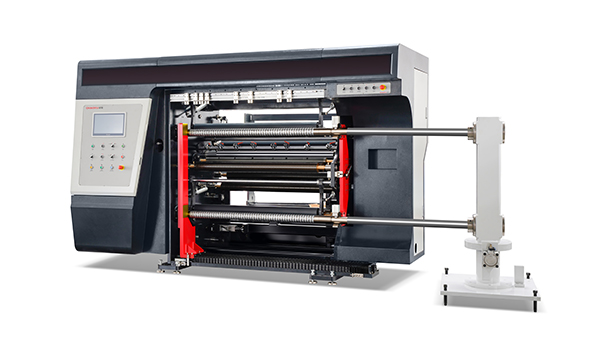
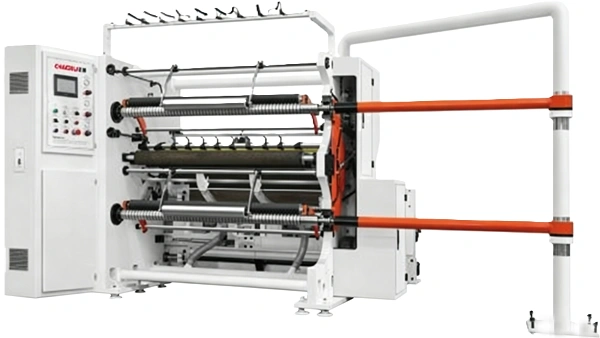
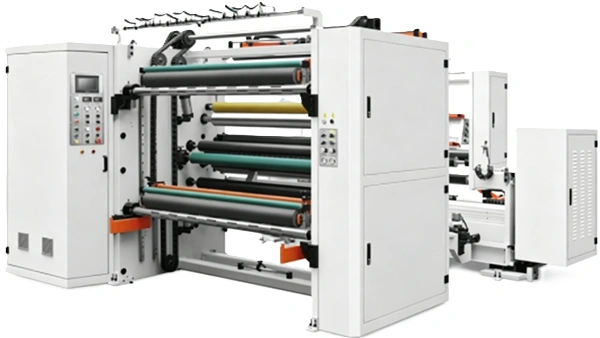
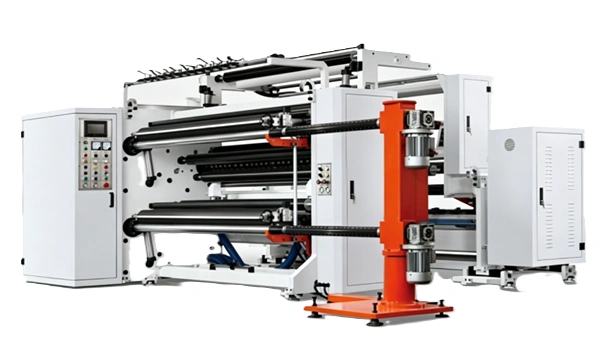
For example, the CHAOXU CX-FQ high-speed slitting machine specifies PLC-based centralized control, touchscreen parameter setting, automatic tension control, EPC, meter counting, roll diameter calculation, and automatic shutdown for meter counting.
These are documented functions of the published CX-FQ configuration. Automatic knife positioning and full job recipe recall should be confirmed separately rather than assumed to be included.
A Practical Slitter Changeover Workflow for Short Runs
Even with automated controls, a consistent operating procedure remains important.
The following sequence provides a practical framework for preparing a new slitting job.
Step 1: Confirm the New Job Specifications
Before making adjustments, review the production order.
Confirm:
-
Incoming material type and thickness.
-
Parent roll width and diameter.
-
Required finished slit widths.
-
Number of finished rolls.
-
Target roll length or diameter.
-
Required winding quality.
This step helps prevent avoidable adjustments caused by incomplete or incorrect production information.
Step 2: Prepare the Knife Arrangement
Calculate the required cutting layout based on the finished roll specifications.
Check blade condition, knife spacing, and cutting alignment. If the machine supports automatic knife positioning, confirm that the saved layout matches the current production order.
Do not assume that changing the target slit width automatically changes the physical knife positions.
Step 3: Set the Tension Parameters
Review the unwinding and rewinding requirements for the new material.
Establish suitable tension values according to material properties, roll dimensions, and winding requirements.
If the machine uses a taper tension system, confirm the relevant winding settings before starting production.
Step 4: Check Web Alignment and Production Monitoring
Verify the edge guiding system and confirm that the material follows the correct web path.
Check the length counter, roll diameter calculation, and automatic stopping conditions where applicable.
Step 5: Conduct a Trial Run and Inspect the Finished Rolls
Start at an appropriate speed and inspect the initial output.
Check:
-
Slitting edge quality.
-
Finished roll width.
-
Web alignment.
-
Roll winding tightness.
-
Wrinkles, telescoping, or other visible defects.
If adjustments are required, identify the cause before increasing production speed.
Step 6: Record the Final Settings
Once the job runs consistently, record the relevant production parameters for future reference.
If the control system supports recipe storage, save the verified settings under a clear job or material identification.
This makes repeat orders easier to prepare and reduces dependence on individual operator memory.
How to Evaluate Whether Automation Actually Reduces Changeover Time
A machine with more automation functions is not automatically faster to change over.
The actual result depends on the number of adjustments involved, how much work is automated, and whether the equipment is suitable for the production mix.
A practical evaluation should compare the same job changeover under consistent conditions.
Record the following information:
| Measurement | What to record |
| Job preparation time | Time spent reviewing the new order |
| Mechanical setup time | Knife adjustment and material preparation time |
| Parameter adjustment time | Time spent entering and checking settings |
| Trial-run time | Time required to achieve acceptable output |
| Startup waste | Material consumed before production approval |
| First-pass quality | Whether the initial finished rolls meet specifications |
| Operator involvement | Number and type of manual interventions |
For a meaningful comparison, use similar materials, roll dimensions, slit widths, operators, and quality requirements.
A reduction in parameter entry time may not produce a significant overall improvement if manual knife positioning or repeated trial runs remain the main bottleneck.
Therefore, the most useful question is not how many automated functions a machine has, but which specific production tasks those functions can simplify.
Short-Run Slitting Machine Setup Checklist
Before selecting or configuring equipment, buyers can use the following checklist:
-
Can operators set and monitor parameters through a centralized touchscreen?
-
Does the control system support storing and recalling job settings?
-
Is knife positioning manual, assisted, or automatic?
-
Can knife layouts be saved for repeat orders?
-
Does the machine provide automatic tension control?
-
Is taper tension available for the required winding process?
-
Does the machine include automatic edge guiding?
-
Are length counting and roll diameter calculation available?
-
Can the machine stop automatically at the required length?
-
Are material changeover procedures clearly documented?
-
Can the supplier demonstrate a changeover using the buyer's actual material and job specifications?
This checklist helps distinguish between basic machine control functions and the additional automation needed for high-mix, short-run production.
Choosing a Suitable Configuration for Your Production Mix
The right equipment configuration depends on the materials being processed, order frequency, finished roll dimensions, and the amount of manual setup work your production team wants to reduce.
For flexible packaging film converters, the key considerations may include tension stability, web guiding, slit width flexibility, and finished roll quality.
For paper and self-adhesive material processing, roll handling, cutting arrangements, rewinding methods, and unloading requirements may deserve more attention.
For example, CHAOXU offers different configurations for film and paper slitting applications.
The CX-FQ high-speed slitting machine is designed for materials including BOPP, PET, CPP, CPE, PVC, aluminum foil, and adhesive paper. Its published configuration includes centralized PLC control, automatic tension control, EPC, length counting, and roll diameter calculation.
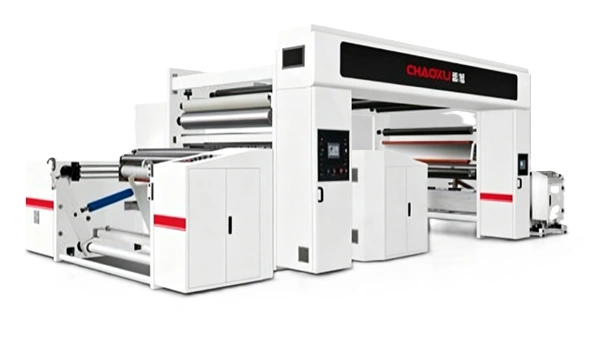
For paper and self-adhesive material processing, the CX-FQ.ZA high-speed paper slitting and rewinding machine provides another configuration to evaluate. Its published features include touchscreen parameter settings, automatic tension control, roll diameter calculation, fixed-length automatic stopping, and automatic unloading.
Buyers should compare these configurations according to their actual materials, roll dimensions, production requirements, and desired automation level.
To review the available options, explore the slitting and rewinding configurations for different roll materials.
You can also review the CX-FQ configuration for film and flexible packaging materials or the paper slitting and rewinding configuration for paper and self-adhesive materials.
Frequently Asked Questions
1. Which machine functions help reduce slitter changeover time?
PLC-based parameter control, touchscreen HMI, accessible job settings, automatic tension control, edge guiding, and automated knife positioning can help simplify different parts of the changeover process. Their actual contribution depends on the machine configuration and production workflow.
2. Does a touchscreen control system automatically include job recipe storage?
No. A touchscreen HMI may allow operators to enter and display operating parameters without supporting multiple saved job recipes. Buyers should confirm whether the selected system includes parameter storage, job identification, and one-touch recall.
3. Is automatic knife positioning necessary for short-run slitting?
Not in every application. It is more relevant when orders frequently require different slit widths and multiple knife position changes. For simpler or less frequently changed layouts, manual positioning may remain practical.
4. How does automatic tension control help when changing orders?
Automatic tension control regulates web tension during unwinding and rewinding. It can reduce repeated manual corrections during operation, but operators still need to establish suitable target settings for each material and winding requirement.
5. Can automatic edge guiding replace manual knife adjustment?
No. Edge guiding controls the position of the incoming web, while knife adjustment determines where the material is cut. They address different aspects of the setup process.
6. How should buyers compare changeover performance between machines?
Use the same material, roll dimensions, slit widths, and quality requirements to evaluate job preparation, knife adjustment, parameter setting, trial running, startup waste, and first-pass quality. A controlled comparison provides a more useful assessment than relying on advertised running speed alone.
Conclusion
Reducing changeover time in short-run slitting production requires more than selecting a machine with a high operating speed. The important factors are how efficiently operators can prepare a new job, adjust the cutting arrangement, establish suitable tension, align the web, and verify the first finished rolls.
PLC-based control, automatic tension regulation, edge guiding, length counting, and roll diameter calculation can support a more organized setup process. Automatic knife positioning and job recipe recall may provide additional benefits when these functions are available in the selected configuration.
Before purchasing, identify the stages that consume the most time in your current workflow and ask the supplier to demonstrate the relevant functions using your actual materials and production specifications.
The goal is not to automate every adjustment unnecessarily, but to choose a configuration that makes frequent order changes more manageable while maintaining consistent slitting and winding quality.